
Do frost-free hose bibs need winterizing? The year one froze on me
Even a frost-free spigot can burst if you leave a hose screwed on over winter, because the hose traps water against the valve where it can freeze. Disconnect every hose, open each spigot to drain it, and if you have an interior shutoff for the outdoor lines, close it and drain the rest. For a spigot with no shutoff, a foam cover is cheap insurance.
- Your hands the disconnect-and-drain part is free
There is a "frost-free" spigot on the back of this house, and the year I learned what those quotation marks are worth was the year I left the garden hose screwed onto it all winter. Frost-free means the valve that actually shuts the water is set back inside the warm wall, so the pipe drains itself when you turn it off. It cannot drain itself if a hose is holding a slug of water against it. That water froze, expanded, split the pipe behind the wall, and I did not find out until I turned the spigot on in April and heard water pouring inside the kitchen wall. That was a pay-the-man day and not a cheap one.
So yes. Even the frost-free ones. Especially if you are a person who leaves hoses on, which I was, exactly once.
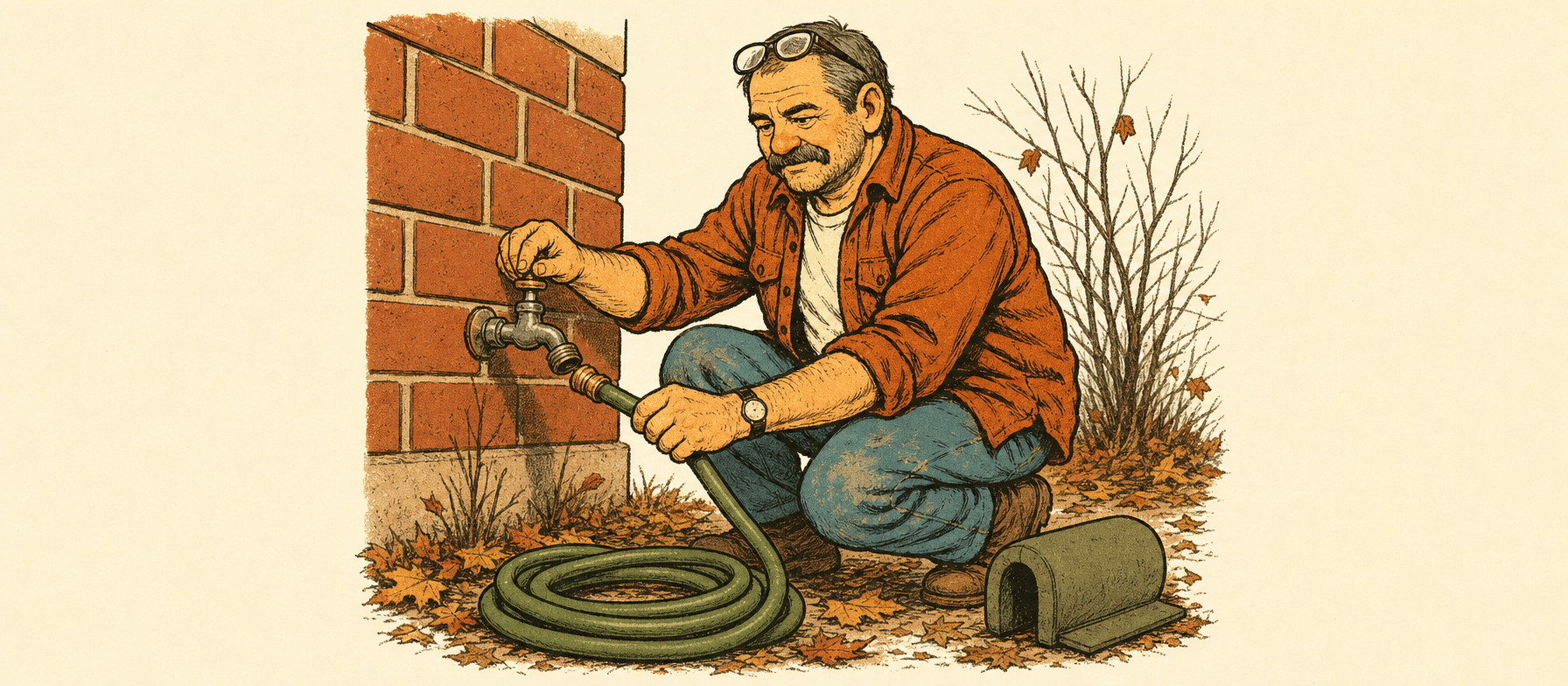
The ten-minute version
- Disconnect every hose. This is the whole ballgame for a frost-free bib. Unscrew it, drain it, coil it in the shed. A hose left on is how the frost-free ones fail.
- Open the spigot and let it run out. On a frost-free, once the hose is off it drains itself back to the valve inside the wall. Leave it open a beat, then close it.
- If you have an interior shutoff for the outdoor lines, and older houses often do, a little valve on the pipe just inside the wall, close it and then open the outdoor spigot to drain what is left in the run. Belt and suspenders.
- For a plain, non-frost-free spigot with no shutoff, slip an insulated foam cover over it. A few bucks, and it buys you a margin against a hard freeze.
What went wrong
Nothing this time, which is the point. This is a job that only goes wrong if you skip it, and I have the split pipe and the plumber's invoice in the spreadsheet to prove what skipping it costs. The whole thing took 25 minutes because I did all four spigots and stood around the last one making sure it drained. Cheapest insurance in the house.
If it already froze
If you forgot, disconnected a hose in spring, turned the spigot on, and heard water where water should not be, shut off the main and stop. A burst pipe inside a wall is not a foam-cover problem anymore. That is the one where you call a plumber before the drywall gets any wetter, and you pay the man, and you write down what it cost so you never leave a hose on again. Ask me how I know.
The Damage
| Item | Where | Cost |
|---|---|---|
| Frost King FC1 outdoor foam faucet cover | Home Depot | $6.98 |
| Sales tax | $0.42 | |
| Total | $7.40 |
Deb's verdict. "You do this every fall now like it owes you money. Good."